Skip to Main Content
I'm looking for

Why Compare Nanosecond and Picosecond Lasers for Melasma?

The choice matters. Melasma can appear as soft brown patches across the cheeks, forehead, or upper lip, yet its causes and responses to treatment vary. A laser’s pulse duration is only one part of the decision. Wavelength, energy, skin type, recent sun exposure, and prior treatments also matter. Dr. Pearl E. Grimes, a dermatologist known for her work on pigmentary disorders, has described melasma as “one of the most challenging disorders to treat.” That difficulty is worth remembering before comparing devices.

This introduction to Melasma Nanosecond Picosecond Laser treatment examines how the two technologies differ without assuming that newer always means better. Nanosecond lasers deliver energy in billionths of a second; picosecond lasers use trillionths. Their effects depend on the device settings and the person’s skin, so published comparisons should be read carefully. Laser treatment may help selected patients, but irritation or post-inflammatory darkening can occur, and pigmentation may return. It is not a guaranteed fix.

A thoughtful comparison asks what evidence supports each approach, which patients were studied, and how outcomes were measured. It also considers the clinician’s experience and the role of sun protection and ongoing care. One limitation deserves attention: studies do not always compare identical settings or patient groups. That makes simple rankings unreliable. For readers weighing options, the practical question is not merely which pulse is shorter, but which plan fits their skin and risk profile.
Why Compare Nanosecond and Picosecond Lasers for Melasma?

What Melasma Is and Why Laser Treatment Requires Careful Selection

Melasma is a chronic pigment disorder that often creates symmetrical brown or gray patches on the cheeks, forehead, and upper lip. It is more than a surface stain: pigment may sit at different skin depths, and sunlight can keep activating it. A clinical and epidemiological review in Anais Brasileiros de Dermatologia reported prevalence estimates of about 1% in the general population and up to 50% in some higher-risk groups; estimates vary with population and study methods (Handel et al., 2014).

Careful assessment matters. Skin tone, patch depth, prior treatments, and triggers such as ultraviolet and visible light can all affect treatment choices. A laser may lighten pigment, but it can also cause irritation or post-inflammatory darkening, especially in more pigment-prone skin. Not a simple trade-off. A review in Dermatology and Therapy describes recurrence and treatment-related pigment changes as continuing challenges in melasma care (Ogbechie-Godec and Elbuluk, 2017).

Nanosecond and picosecond lasers deliver energy over different pulse durations, but a shorter pulse does not automatically mean safer or better results. Clinicians weigh settings, test areas, skin response, and whether laser treatment is appropriate at all. Daily broad-spectrum sun protection remains essential; visible-light protection may also be discussed. The choice can be less obvious than a device comparison suggests. Individual responses vary.

Why Compare Nanosecond and Picosecond Lasers for Melasma?

Melasma is a chronic pigmentary condition that can recur, so treatment choice requires care. This chart compares pulse duration only—not treatment effectiveness or safety.

How to read it: The examples shown are 10 nanoseconds (10,000 picoseconds) and 750 picoseconds. Actual pulse durations vary by laser system. A shorter pulse does not by itself mean a better melasma outcome. Lasers may cause irritation or post-inflammatory darkening in some people; a qualified clinician should weigh skin type, pigment pattern, prior response, and other treatment options.

How Nanosecond and Picosecond Lasers Deliver Energy to Pigment

Why Compare Nanosecond and Picosecond Lasers for Melasma?

How Nanosecond and Picosecond Lasers Deliver Energy to Pigment

The key difference is pulse duration. A nanosecond is 10⁻⁹ seconds; a picosecond is 10⁻¹² seconds. That makes a picosecond pulse 1,000 times shorter. In selective photothermolysis, described by Anderson and Parrish in Science (1983), treatment depends on matching light delivery to a target’s absorption and heat dissipation. Melanin absorbs laser energy, but the surrounding skin can also respond.

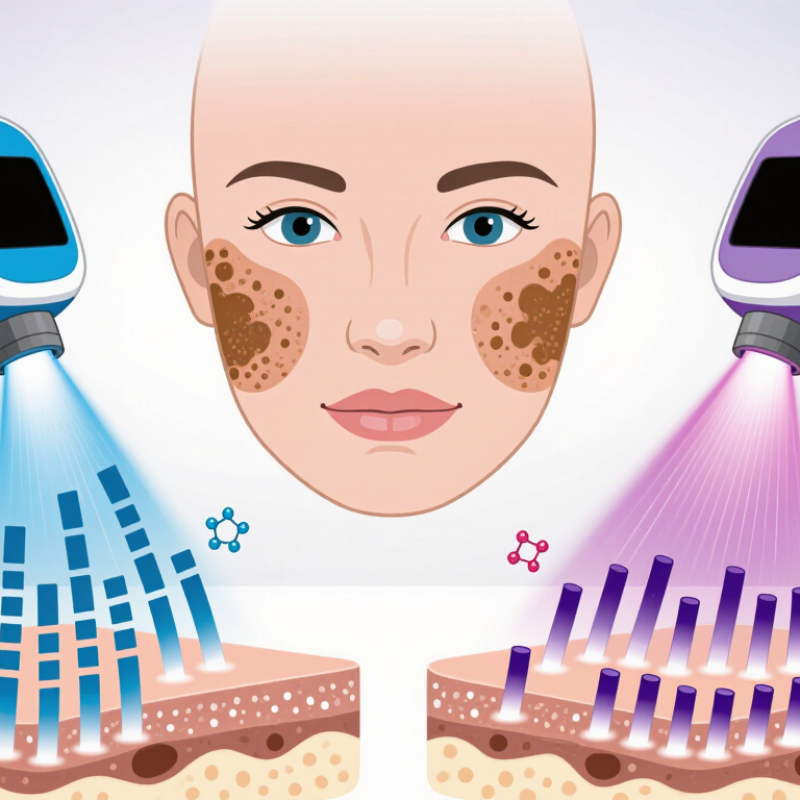
Nanosecond pulses deliver energy over a longer interval, with more opportunity for heat to spread. Picosecond pulses compress delivery into a shorter burst and can create stronger photoacoustic effects, which break pigment into smaller fragments. That does not guarantee better melasma control. The condition involves more than visible pigment, and inflammation or excess treatment may worsen discoloration. Clinical reviews of laser treatment for melasma report varied outcomes and note recurrence as a practical concern. Evidence is not perfectly tidy.

In practice, clinicians consider wavelength, fluence, spot size, skin tone, and the patient’s history—not pulse duration alone. A test spot can reveal how skin responds, though it cannot predict every outcome. Tiny details matter. The safest comparison is about energy delivery and individual response, not a promise that one pulse type always wins.

Key Differences in Pigment Response and Skin Effects

Why Compare Nanosecond and Picosecond Lasers for Melasma?

Nanosecond and picosecond lasers differ mainly in pulse duration: one emits energy over billionths of a second, the other over trillionths. Both target melanin, but shorter pulses can break pigment into smaller particles with less heat spreading into nearby skin.

That distinction sounds neat. Real skin is less predictable. Melasma pigment may sit at different depths, and heat, irritation, or sunlight can trigger darker patches, especially in deeper skin tones.

Clinical results remain mixed. A Cochrane review by Rajaratnam and colleagues included 20 trials involving 2,125 people across melasma treatments, but found limited evidence for choosing one treatment over another (Cochrane Database of Systematic Reviews, 2010; CD003583).

Laser studies are often small, use different settings, and track outcomes for short periods. A fading patch is not always lasting improvement. Nanosecond treatment has a longer clinical track record, yet repeated sessions may irritate skin or cause mottled light spots.

Picosecond devices may reduce thermal spread, but they do not eliminate post-inflammatory darkening or recurrence. A dermatologist should assess skin tone, pigment depth, and prior reactions before treatment.

Ask about eye protection and test spots, too. The evidence still needs better long-term comparisons.

Comparing Clinical Evidence, Benefits, and Potential Risks

Nanosecond and picosecond lasers deliver energy in different pulse durations, but neither is automatically better for melasma. Both may target excess pigment, and some patients see gradual lightening after treatment. However, clinical studies vary in laser settings, skin types, treatment schedules, and outcome measures. Direct comparisons remain limited. Evidence remains mixed.

Potential benefits should be weighed against the condition’s tendency to return. Heat and inflammation can trigger post-inflammatory darkening, especially in more pigment-prone skin. Redness, irritation, and uneven light or dark patches are also possible. A shorter pulse does not guarantee a safer result. That matters.

A qualified dermatologist can assess the pattern of pigmentation, skin tone, medical history, and previous treatment reactions before recommending a procedure. Ask what improvement is realistic, how many sessions may be needed, and how complications would be managed. Sun protection and suitable topical care remain important, since ultraviolet and visible light can sustain melasma. No laser is a shortcut. Even with careful settings, responses differ, and choosing treatment can involve some uncertainty.

Factors That Guide Laser Choice for Melasma Treatment

Why Compare Nanosecond and Picosecond Lasers for Melasma?

Choosing a laser for melasma involves more than comparing pulse duration. A clinician should assess the pigment’s pattern, depth, skin tone, and the patient’s treatment history. Brown patches across the cheeks may look similar, yet respond differently. Some discoloration also has mixed causes.

Nanosecond lasers deliver energy in billionths of a second; picosecond devices use even shorter pulses. These differences may affect how pigment absorbs and disperses energy, but they do not guarantee better results. The right choice depends on the individual and the treatment settings. Skin sensitivity matters. A history of irritation or post-inflammatory darkening may call for a cautious plan, or a different approach. Melasma can worsen after excessive heat or inflammation.

A qualified clinician should explain likely benefits, risks, and alternatives before treatment. They may recommend a small test area, especially when skin is prone to pigment changes. Ask how many sessions might be needed, what downtime to expect, and how results will be monitored. Daily sun protection remains important; treatment alone rarely prevents recurrence. One detail is easy to overlook: visible improvement can fluctuate with sun exposure, hormones, and heat. Even careful plans can miss something. Regular review helps clinicians adjust treatment rather than simply increasing energy.

Contact us