What Are the Top Types of Medical Roll Paper?
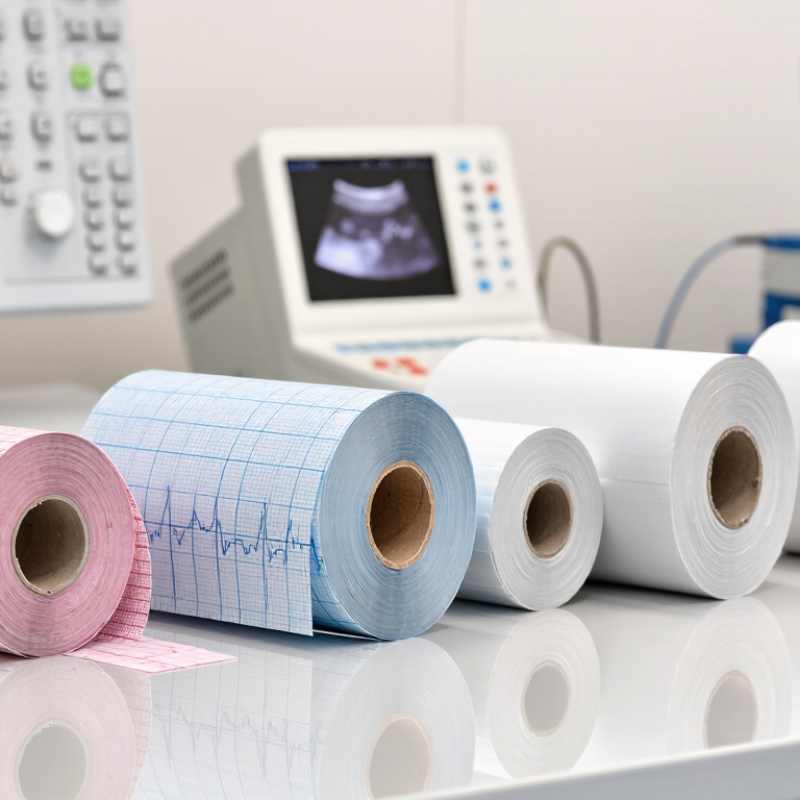
Medical Roll Paper may look like a simple supply, but the wrong roll can leave faint traces, clipped readings, or paper that will not fit the device. Buyers commonly compare ECG, fetal-monitor and cardiotocography, ultrasound, and other chart or thermal rolls. Each serves a different recording system. Width, core diameter, grid, roll length, and thermal coating matter at the point of use. Small details, perhaps too easily overlooked.
Grand View Research valued the global medical devices market at $512.29 billion in 2022 and projected 5.9% compound annual growth through 2030. That figure covers medical devices broadly, not roll paper specifically. It does, however, show the scale of the equipment environment these consumables support. For ECG recording, AAMI’s EC11 standard provides requirements for diagnostic electrocardiographic devices; purchasers should still confirm paper compatibility with the exact model and manufacturer guidance. A correct-looking roll is not always a correct match.
Dr. Paul Batalden, a physician and healthcare-quality expert, is widely associated with this maxim: “Every system is perfectly designed to get the results it gets.” It is not a quotation about roll paper itself, but it offers a useful purchasing lens: supply choices affect routine work. A practical comparison should check print technology, calibration grid, storage conditions, and supplier specifications—not just price. There is room for caution here. Product labels can be vague, and a neat checklist cannot replace testing a sample in the actual monitor. The sections ahead compare the main roll types, their uses, and the details worth verifying before ordering.
Examination Table Paper for Patient Care Settings
Examination table paper is a disposable barrier between the patient and the table surface. It is practical during quick appointments: pull a fresh sheet, position it over the cushion, and tear it away after use. The CDC’s 2015 national survey estimated that about one in 31 U.S. hospital patients had at least one healthcare-associated infection on a given day (CDC, 2018). WHO’s 2022 global report estimated that 7 in 100 patients in acute-care hospitals in high-income countries acquire at least one infection during care. These figures describe different settings and measures. They underline why reliable cleaning routines matter, but they do not show that table paper prevents infection.
Choose paper by matching roll width to the table, and check that the sheet stays in place when a patient sits or turns. Perforations make changes quicker. A soft, low-noise sheet can also make an exam feel less clinical. Small details count. Staff should remove used paper between patients and clean the surface according to facility procedures; paper is not a substitute for disinfection. Check roll fit and tearing during a normal shift, not only when ordering. The awkward part is that thinner paper may tear easily, while heavier paper can be less comfortable on warm skin. There is no single best roll for every clinic. Sources: CDC, 2015 National Healthcare Safety Network Healthcare-Associated Infection Prevalence Survey (published 2018); WHO, Global Report on Infection Prevention and Control, 2022.
Medical Roll Paper: Common Types and Table Paper Widths
Examination table paper is commonly available in nominal widths such as 18, 21, and 24 inches; availability varies by supplier. Common options include smooth, crepe, embossed, recycled-fiber, and poly-backed paper. Choose a width that fits the table, and select the paper construction based on the setting’s coverage and barrier needs.
ECG Paper for Recording Cardiac Activity
ECG paper turns a brief electrical recording into a trace clinicians can inspect. Its fine grid helps show timing and voltage: small squares commonly measure 1 mm, while darker lines mark larger intervals. At a paper speed of 25 mm per second, each small square represents 0.04 seconds horizontally. A familiar calibration is 10 mm per millivolt vertically, though settings can differ. Check the machine’s printed calibration before interpreting a tracing.
A clear record depends on more than the paper. The roll must feed evenly, fit the recorder, and produce lines that remain easy to read. Thermal paper is sensitive to heat and light, so storage conditions matter; printed traces may fade over time.
Keep records protected, and follow the equipment instructions for compatible paper and storage. Small details count. A skewed grid or faint trace can make measurement harder, especially when comparing recordings.
ECG paper supports clinical review, but it does not diagnose a condition by itself. I would also avoid assuming every chart uses identical settings; confirm the speed and gain shown on each printout.
Ultrasound Paper for Printing Diagnostic Images
Ultrasound paper is a specialized type of medical roll paper used to print diagnostic images from compatible ultrasound systems. Many printers use heat-sensitive paper, creating grayscale images without ink or toner. The result is quick and convenient, especially when staff need a physical image for a patient record or consultation. Small detail. Roll width, core size, and paper coating must match the printer’s specifications. A roll that feeds poorly can wrinkle, shift, or waste image sections.
Image quality depends on more than the printer. A consistent coating helps preserve fine shades between dark structures and lighter tissue, while a clean print head can reduce streaks. Paper also needs sensible storage. Heat, strong light, and moisture may affect printed images over time, so follow the printer and paper supplier’s guidance for handling and retention.
Thermal prints are useful, but they may not be the best long-term archive in every setting. That part is easy to overlook. Staff should confirm that images remain legible for their intended clinical use and follow local recordkeeping procedures. Medical roll paper sounds routine; in practice, choosing the right roll can prevent avoidable interruptions.
Fetal Monitor Paper for Tracking Labor and Delivery
Fetal monitor paper is designed to record a baby’s heart rate alongside contractions during labor. On the moving strip, clinicians can see two traces against a printed time grid. The upper trace commonly shows fetal heart rate; the lower shows uterine activity. Clear lines matter. Faint printing, a skewed grid, or a paper jam can make a trace harder to interpret. Roll width, core size, grid scale, and feed direction must match the monitor’s specifications; formats are not universally interchangeable.
Evidence puts the paper in perspective. A 2017 Cochrane review of 13 trials involving more than 37,000 women found continuous cardiotocography was associated with fewer neonatal seizures than intermittent listening, but more cesarean and assisted vaginal births. The review found no clear reduction in perinatal mortality. These findings support careful interpretation, not treating a printed strip as a diagnosis. A trace needs clinical context. Staff should check that the recording is legible, the time scale is understood, and the paper supply will last through monitoring. Paper checks can feel mundane, and that is exactly why they may be missed. A clean strip helps; it cannot replace trained assessment or the birthing person’s wider care. (Alfirevic et al., Cochrane Database of Systematic Reviews, 2017, CD006066.)
Sterilization Paper Rolls for Packaging Medical Instruments
What Are the Top Types of Medical Roll Paper?
Sterilization Paper Rolls for Packaging Medical Instruments
Sterilization paper rolls are used to package instruments before processing and storage. Many combine medical-grade paper with a transparent film, so staff can inspect contents and identify instruments without opening the pack. The roll format allows teams to cut sleeves to suit different instrument lengths. Choose a width that leaves enough room around the item for sealing and handling. Too much space can make packs awkward; too little may strain the seams. Small details matter.
The packaging material must be compatible with the intended sterilization method and follow the equipment and material instructions. Check that seals are continuous, the paper is dry and undamaged, and any process indicators are suitable for the workflow. A clear change in an indicator is useful, but it does not replace validated processing or routine monitoring. Cut cleanly, seal evenly, and avoid sharp tips pressing against the package. In practice, busy teams can miss a tiny channel in a seal. That deserves a second look. After processing, inspect each pack for tears, moisture, or failed seals before storage or use. Do not treat a paper roll as a shortcut around established procedures.


