Skip to Main Content
I'm looking for

Top Wound Products Manufacturers and Suppliers Worldwide

Choosing reliable Wound Products requires more than comparing prices or browsing polished supplier websites. Hospitals, clinics, distributors, and home-care providers need materials that perform consistently under real conditions. A sterile dressing may look excellent online, yet its seal, absorbency, or skin comfort can determine patient outcomes. Small details matter.

This guide examines leading wound product manufacturers and suppliers worldwide. It considers dressings, bandages, gauze, foam products, hydrocolloids, alginates, antimicrobial options, and related accessories. The evaluation focuses on manufacturing experience, product specifications, quality systems, clinical evidence, packaging integrity, and supply reliability. It also considers whether suppliers provide clear instructions, batch information, storage guidance, and responsive technical support.

Evidence matters more than marketing language. Reputable companies should explain how products are tested and where their materials come from. Certifications can support confidence, but they should be checked against current regional requirements. A supplier serving Europe may follow different documentation expectations from one serving North America, Asia, or the Middle East. Local approval still matters.

No manufacturer is perfect. Even established suppliers may face delays, limited stock, or inconsistent communication. That reality deserves attention. Product selection should match wound type, exudate level, skin condition, clinical protocol, and professional judgment. The discussion here is informative, not a substitute for medical advice or institutional purchasing procedures. Readers should verify current certifications, independent reviews, and regulatory status before making a decision. A practical choice is not always the cheapest one. It is the option that remains dependable when a dressing must protect fragile skin during a difficult shift.
Top Wound Products Manufacturers and Suppliers Worldwide

Wound Product Manufacturers and Suppliers: Global Industry Overview

The global wound product industry is shifting from basic dressings toward evidence-led, complete care pathways. A 2024 Grand View Research report valued the advanced wound care market at approximately USD 11.6 billion in 2023. It expects continued growth through 2030, driven by diabetes, aging populations, surgery, and hospital-acquired wounds.

Manufacturers now supply foam dressings, hydrocolloids, alginates, antimicrobial materials, negative-pressure systems, and skin-protection products. Reliable suppliers usually document material safety, sterility, shelf life, and clinical performance. Many facilities also assess ISO 13485 quality systems and regional medical-device requirements before purchasing. A product may look simple. Its testing is not.

Global sourcing remains uneven. Large healthcare systems often request temperature-controlled logistics, multilingual instructions, batch traceability, and stable supply contracts. Smaller clinics may prioritize unit cost, but poor absorption can increase dressing changes and nursing time. The calculation becomes less obvious. According to a 2023 report from Fortune Business Insights, the broader wound care market was valued at over USD 20 billion, with moderate growth projected this decade. However, published market estimates differ because reports classify products differently. That limitation deserves attention. Manufacturers and suppliers should therefore present clinical evidence, transparent specifications, and realistic use conditions instead of relying on attractive market claims.

Major Categories of Wound Care Products

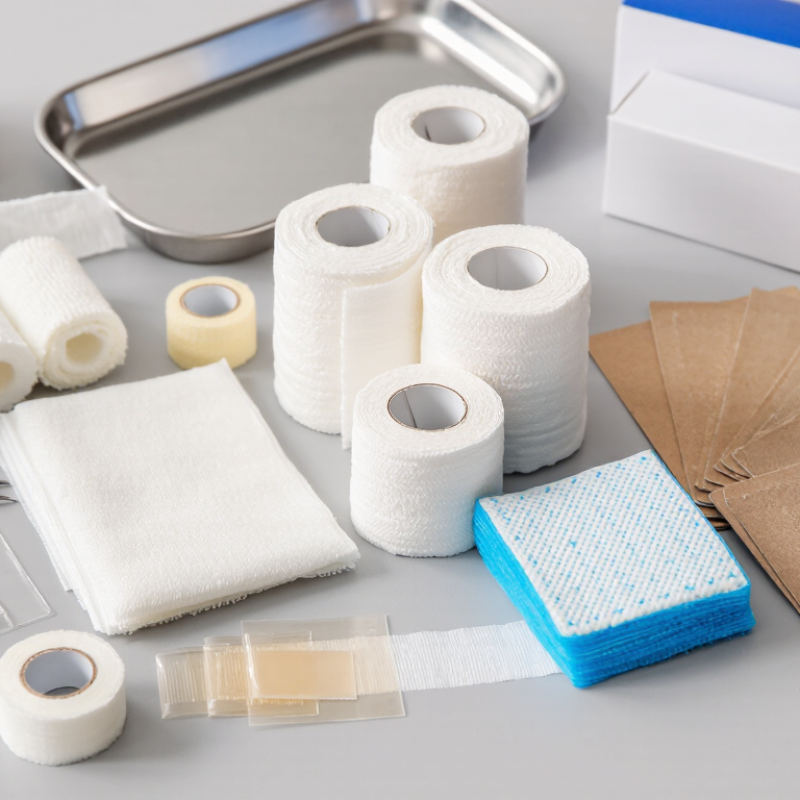
Wound care products fall into several major categories, each serving a different clinical purpose. Basic dressings protect the wound, absorb drainage, and reduce contact with outside contaminants. Gauze, nonwoven pads, foam dressings, and absorbent fibers are common choices. Selection depends on exudate volume, wound depth, skin condition, and dressing frequency. Fit matters. A practical assessment should guide every product decision.

Advanced dressings manage specific healing environments. Hydrocolloids support moist conditions, while hydrogels add moisture to dry or necrotic tissue. Alginate and gelling fiber dressings can help control moderate to heavy exudate. Antimicrobial dressings may support care when infection risk is clinically identified, but they should not replace assessment or prescribed treatment. Negative pressure wound therapy uses controlled suction and specialized seals. It requires trained application and regular monitoring.

Other important categories include wound cleansers, skin barriers, compression systems, fixation products, and closure materials. Cleansers should be gentle and suitable for exposed tissue. Skin protectants help reduce damage from moisture and adhesive removal. Compression products require careful evaluation of circulation. Suppliers also need reliable sterilization records, clear instructions, lot traceability, and consistent quality testing. These details affect real-world safety. Packaging can fail, measurements can be misunderstood, and no product performs perfectly in every wound. Manufacturers should acknowledge these limits and provide evidence-based guidance rather than broad promises.

Top Wound Products Manufacturers and Suppliers Worldwide - Major Categories of Wound Care Products
Major Product Category Common Product Types Typical Materials or Active Components Primary Wound-Care Function Common Clinical Applications Typical Supply Formats Key Selection Considerations
Gauze and Non-Woven Dressings Sterile gauze pads Non-woven sponges Gauze rolls Abdominal pads Cotton, rayon, polyester, polypropylene, or blended non-woven fibers Absorption, wound coverage, cleansing, and secondary dressing support Minor cuts, post-operative wounds, traumatic wounds, and general wound packing when clinically appropriate Individually wrapped sterile units, bulk sterile packs, and non-sterile rolls Absorbency, linting, fiber shedding, edge construction, sterility, and ease of removal
Transparent Film Dressings Adhesive films Catheter-site films Wound-viewing films Transparent polyurethane film with pressure-sensitive adhesive Protects against external contamination while allowing moisture vapor exchange and wound observation Superficial wounds, intravenous catheter sites, incision protection, and securement of primary dressings Sheets, rolls, and pre-shaped sterile dressings Adhesion, conformability, breathability, skin sensitivity, and resistance to fluid leakage
Hydrocolloid Dressings Thin hydrocolloids Extra-thick hydrocolloids Sacral shapes Gel-forming particles such as carboxymethylcellulose, pectin, or gelatin in an adhesive matrix Maintains a moist wound environment and forms a gel when exposed to wound fluid Low-to-moderately exuding superficial wounds, pressure injuries, and selected partial-thickness wounds Adhesive sheets in rectangular, oval, or anatomical shapes Exudate level, periwound skin condition, wear time, odor during dressing change, and avoidance on clinically infected wounds unless directed
Hydrogel Dressings Amorphous gels Impregnated gauze Sheet hydrogels Water-based polymers, often containing glycerin, propylene glycol, or other humectants Donates moisture, supports autolytic debridement, and may help cool painful wound surfaces Dry or minimally exuding wounds, sloughy wounds, and selected burns or painful superficial wounds Tubes, sterile sachets, bottles, and preformed sheets Hydration needs, exudate level, secondary dressing requirements, and risk of maceration
Foam Dressings Polyurethane foam Silicone-border foam Heel and sacral foam Open-cell polyurethane foam, sometimes combined with a silicone contact layer or waterproof backing Absorbs wound exudate, cushions the wound, and supports a moist healing environment Moderately to highly exuding wounds, pressure injuries, venous leg ulcers, and post-operative wounds Adhesive and non-adhesive sheets, cavity shapes, and anatomical designs Fluid-handling capacity, dressing thickness, conformability, atraumatic removal, and compatibility with compression therapy
Alginate and Hydrofiber Dressings Calcium alginate Calcium-sodium alginate Gelling fiber Rope dressings Seaweed-derived alginate fibers or sodium carboxymethylcellulose fibers Absorbs exudate and forms a gel or cohesive layer that can support moist wound management Moderately to highly exuding wounds, cavities, and wounds with minor bleeding where the product labeling permits Flat pads, ribbons, ropes, and cavity fillers Exudate volume, cavity depth, ease of removal, need for a secondary dressing, and avoidance in dry wounds
Antimicrobial Dressings Silver dressings Iodine dressings PHMB dressings Medical honey dressings Elemental or ionic silver, iodine compounds, polyhexamethylene biguanide, or medical-grade honey Helps manage bioburden on selected wounds as part of an overall wound-care plan Wounds at risk of local microbial burden, infected wounds under clinical management, and selected burns depending on product labeling Sheets, gels, impregnated dressings, ropes, and ointment-like preparations Active ingredient, contact time, exudate level, contraindications, allergy history, duration of use, and antimicrobial stewardship
Contact Layers and Non-Adherent Dressings Silicone contact layers Petrolatum gauze Low-adherent pads Soft silicone mesh, knitted fabric, petrolatum, or other non-adherent coatings Protects the wound bed and reduces trauma during dressing changes Fragile skin, skin tears, graft donor sites, burns, superficial wounds, and wounds requiring a secondary absorbent dressing Sheets, mesh rolls, and impregnated gauze pads Atraumatic removal, wound-bed protection, drainage passage, fixation method, and compatibility with the secondary dressing
Collagen and Extracellular-Matrix Dressings Collagen sheets Collagen particles Composite matrices Purified bovine, porcine, equine, or other tissue-derived collagen and extracellular-matrix components Provides a structural matrix and may support management of selected chronic wounds Some chronic ulcers and wounds with stalled healing, subject to clinical assessment and product indications Sheets, powders, particles, and composite dressings Source material, patient sensitivity, wound-bed preparation, exudate level, storage conditions, and regulatory indications
Compression and Offloading Products Compression bandages Compression hosiery Tubular bandages Offloading felt Elastic or inelastic textile systems, padding layers, foam, and pressure-distributing materials Controls edema, improves venous return, protects vulnerable areas, and redistributes mechanical load Venous leg ulcers, lower-limb edema, pressure redistribution, and diabetic foot offloading when clinically suitable Short-stretch and long-stretch bandages, multilayer kits, hosiery, sleeves, and shaped pads Vascular assessment, target pressure, limb shape, application skill, patient mobility, and monitoring for complications
Negative Pressure Wound Therapy Supplies Foam dressings Gauze dressings Sealing drapes Tubing and canisters Open-cell foam or gauze, occlusive film drapes, fluid-collection canisters, and suction tubing Applies controlled subatmospheric pressure to manage exudate and support granulation in selected wounds Complex surgical wounds, traumatic wounds, dehisced wounds, and selected chronic wounds under professional supervision Disposable dressing kits, canisters, tubing sets, and therapy-specific accessories Wound characteristics, seal integrity, pressure settings, bleeding risk, anatomical location, and trained clinical application
Skin Protection and Periwound Care Barrier films Barrier creams Ointments Adhesive removers Silicone-based polymers, acrylate barrier formulations, dimethicone, zinc oxide, or solvent-free adhesive removers Protects periwound skin from moisture, adhesive trauma, friction, and irritants Moisture-associated skin damage, incontinence-associated dermatitis, high-exudate wounds, and repeated adhesive use Wipes, sprays, foams, creams, ointments, and liquid applicators Skin tolerance, drying time, compatibility with adhesives, frequency of application, and avoidance of contamination
Wound Cleansing and Debridement Products Sterile saline Wound irrigation solutions Cleansing gels Debridement aids Sodium chloride solutions, purified water-based formulations, surfactants, and other labeled cleansing agents Removes loose debris, exudate, and surface contaminants; supports preparation of the wound bed Acute wounds, chronic ulcers, surgical wounds, and wounds requiring routine cleansing Single-use ampoules, bottles, irrigation bags, sprays, gels, and applicator systems Sterility, solution compatibility, delivery method, tissue tolerance, contamination control, and clinical protocol
Fixation and Securement Products Medical tapes Retention bandages Tubular retainers Adhesive borders Paper, non-woven fabric, polyurethane, silicone adhesive, acrylic adhesive, or elastic knitted textiles Secures primary and secondary dressings without unnecessarily disturbing the wound Routine dressing fixation, fragile skin, areas exposed to movement, and difficult anatomical contours Rolls, strips, pre-cut pieces, tubular nets, and integrated adhesive borders Adhesive strength, skin sensitivity, stretch, moisture resistance, removal trauma, and anatomical fit
Product selection should be based on wound assessment, exudate level, tissue condition, infection status, patient factors, and the applicable instructions for use.

How Leading Manufacturers Develop and Produce Wound Products

Leading wound product manufacturers begin with clinical needs, not factory capacity. They study exudate levels, skin sensitivity, movement, and dressing changes. Nurses and wound specialists often review early designs. Their feedback can expose problems that laboratory tests miss.

Production starts with carefully selected materials, such as absorbent fibers, breathable films, gentle adhesives, and protective backing layers. Engineers control thickness, moisture handling, and flexibility during converting. Clean manufacturing areas reduce contamination risks. Each batch receives identification codes for traceability. Sterility validation, biocompatibility testing, and packaging inspections support product reliability.

Details matter. A sealed pouch must resist damage during shipping. A dressing should open easily without tearing. It must also remain comfortable around fragile skin. No process is flawless. A prototype may perform well on a test surface but feel unsuitable during a long clinical shift. Manufacturers therefore compare laboratory results with practical observations and revise the design when evidence disagrees. Quality teams review equipment settings, sampling records, and deviations before release. This disciplined approach helps suppliers produce consistent wound products for hospitals, clinics, and home care environments worldwide.

Key Global Markets and Distribution Networks

Wound product manufacturers and suppliers serve highly varied healthcare markets worldwide. Demand differs between urban hospitals, rural clinics, home-care providers, and emergency services. Product selection depends on wound type, reimbursement systems, clinical routines, and local purchasing policies. A distributor in Western Europe may prioritize advanced dressings and traceable documentation. A supplier serving Southeast Asia may need smaller packs, stable shelf life, and reliable temperature control.

Distribution networks usually combine regional warehouses, authorized medical suppliers, and hospital procurement platforms. Central warehouses can support consistent inventory across several countries. Local partners provide practical knowledge about customs procedures, language, storage conditions, and delivery schedules. In large markets, suppliers often use multiple stocking points to reduce transport time. A shipment delayed at one border should not stop essential clinic orders.

Quality depends on more than manufacturing capacity. Buyers should review technical files, batch records, sterilization evidence, complaint procedures, and post-market monitoring. Clear lot numbers matter when nurses inspect cartons under bright treatment-room lights. Cold-chain requirements, when applicable, must be measured and documented during transit. Not every distribution model works equally well. Forecasts can miss seasonal injuries, funding changes, or sudden hospital demand. Suppliers need safety stock, but excess inventory may expire before use. Regular audits, demand reviews, and direct feedback from clinical teams help expose these weaknesses. Locally trained support staff can also improve product handling and reduce avoidable application errors.

Standards for Evaluating Wound Product Suppliers

Top Wound Products Manufacturers and Suppliers Worldwide

Standards for Evaluating Wound Product Suppliers

Reliable supplier evaluation begins with evidence, not attractive catalogs. Ask for ISO 13485 certification, batch traceability, complaint records, and clinical performance data. The International Diabetes Federation estimates that 537 million adults lived with diabetes in 2021. This increases demand for dependable wound management products. Suppliers should explain how their products support diabetic, surgical, and pressure-related wounds.

Regulatory documentation must match the destination market. Review sterility validation, shelf-life testing, biocompatibility reports, and packaging integrity results. The World Health Organization reports that healthcare-associated infections affect about 7% of hospitalized patients in high-income countries. Therefore, suppliers should demonstrate practical infection-control procedures, not only provide certificates. Ask whether production sites conduct routine environmental monitoring and recall simulations. A supplier that cannot answer clearly deserves closer review.

Tips: Request three recent certificates and one independent clinical report. Check whether study populations resemble your patients. Confirm delivery performance over twelve months, not one successful shipment. Pricing matters, but low prices can hide weak evidence. I have seen technically impressive products fail because instructions were unclear. That risk is easy to underestimate. Evaluate user training, multilingual labeling, storage requirements, and post-market support. Also examine whether claims remain consistent across brochures, technical files, and sales conversations. Small inconsistencies may signal larger quality problems. ISO 13485 alignment is useful, but it does not replace clinical judgment or local regulatory verification.

This illustrative supplier-evaluation framework reflects commonly used requirements for wound-care products, including ISO 13485 quality systems, regulatory compliance, sterilization validation, biocompatibility, clinical evidence, supply continuity, and post-market surveillance. The percentages represent suggested procurement weights rather than company or brand performance data.

Contact us